Calypso Music In Trinidad And Tobago
Trinidad and Tobago are two islands in the south-eastern Caribbean that have cultural and ethnic influences from West Africa, France, Britain, India, and more. These combined cultures helped form what is now their most important form of music: Calypso. After gaining popularity in the early 1900s, Calypso has influenced so many parts of the world and although it is not as popular today, its impact still stands.
Origins:
Calypso originated from mostly West African culture after slaves were brought over to Trinidad and Tobago by European colonizers. The slaves were forbidden from communicating with one another, so they decided to use song as a form of communication instead. The songs were taken from the African folk genre called gayup, but were also heavily influenced by cultures from Spain, France, and Britain. After slavery has ended in the mid 1800s, the former slaves began to spread their newfound style through the islands during the French Carnival season. Calypso began to become more mainstream by the early 1900s and was used as a way to spread news and political commentary since there was no written form of communication. In short, Calypso is like a musical version of CBS. Eventually Calypso would grow to be exponentially important to the people of Trinidad and Tobago and still is today.
Here is a video explaining in further detail the origins of calypso. In it you can hear the people of Trinidad and Tobago singing in Patois, a mixture of French and African languages. This video brings a good light on the power and awareness that the calypso genre brought to African slaves during the 1800s and shows how calypso came to be through that.
Elements:
Calypso can be described as carefree and lively, with an energetic tempo in duple meter that is easy to dance to. In the past, Calypso was more somber and slow with a minor key, but today it is a lot faster and major. Calypso music usually features some sort of call-and-response with a main vocalist and often includes a steelband, which I will touch on below.
The lyrics of Calypso were originally in Patois French but were since then turned into English. Since Calypso is a form of news communication, the topics commonly cover political and social issues such as racial inequality, government corruption, and civil rights. The lyrics will even go as far as directly addressing politicians as a way to express the Calypsonian's political views. They typically do so by using the Calypso song's usual structure, which consists of a self-promoting beginning and a second section that scorns and insults the opposing side. The satirical lyricism of these songs were not taken lightly by the British government when they first began. Many of the Calypso songs were censored and monitored because of their controversial topics. Fortunately however, many well-known Calypsonians are still able to carry out their political messages through Calypso.
Calypsonians were typically men, but more recently women have become more common in the art. They perform their songs in tents set up around the islands, with a steelband of up to 150 members accompanying them. Calypsonians go by stage names that reflect their status and identity, and these names are usually very extravagant, political, and regal sounding. Calypso artists include Atilla the Hun, Black Stalin, and Growling Tiger.
Here is an example of older Calypso music. This particular piece is by Atilla the Hun and is about the history of carnival, as signified by the title. The piece features many of the big band elements that jazz did, with brass and winds as well as guitar. Although there doesn't seem to be any percussion, there is still a very distinct beat that is very syncopated and energetic. Much like the African Griot, Atilla the Hun is telling a story in the form of a song that expresses the history of the culture of Calypso.
Here is a video from the 2016 Calypso Festival competition. In this the calypsonian Duane O'Connor sings a song called, "Modern Nursery Rhymes." Much like the first example, this song combines rhythms of Africa and modern band instruments, and has a storytelling element as well. I love how festive and happy Duane sounds and looks in this video. His expression and flow is so captivating and it makes the song even more enjoyable. You can see as he begins singing the chorus that there is a group of singers behind him participating in call-and-response. There are also steelpans and African percussion involved, making the rhythms much more reminiscent of Afro-Carribbean culture. This song uses both concepts of self-glorification and scorn towards an opposing person. I highly recommend watching this amazing performance!
Soca and Rapso:
Soca is a form of calypso that follows elements of soul music and combines calypso and Indian cultures. It is a more modern form of calypso that features technology and modern band instruments, utilizing big band elements similar to jazz and rock. Combining soul and traditional Indian, the soca features Indian rhythms underneath American gospel vocals. There are also many different version of soca that each have their own cultural influence and style:
Chutney- Based on East Indian culture and includes a combination of English and Hindi lyrics
Raga- Jamaican influence
Afrosoca- Nigerian influence
Groovy Soca- A form of soca with a more relaxed feel
Power Soca- A more energetic from of soca that is commonly used in night clubs
Steelband- Soca that has a heavy use of steelbands
Parang- Soca that includes Spanish lyrics
Bouyon- Dominican influence
Bashment- Barbadian influence
Here is an example of a soca song called "Wotless" by Kes The Band. This song features a distinct calypso feel but is definitely also influenced by other cultures. The harmonies are reminiscent of American gospel and even African choirs. This song is also obviously modernized and features modern instrumentation and technology. This song is very catchy and I could dance to this for a while!
Rapso is another form of calypso that is more heavily influenced by hiphop. Rapso usually features lyrics about everyday street life and black empowerment, and includes many features from Jamaican reggae.
Here is a Rapso song called "Dancin Shoes Rapso" by Brother Resistance. The beats are very reminiscent of hiphop culture and features a lot of rapping, but also a lot of steelpans and choral singing. There are also some rhythms from reggae and even some elements of disco. This is definitely a dance piece but also promotes black culture and empowerment.Steelpans and Steelbands:
The steelpan or "steeldrum", is an idiophone native to Trinidad and Tobago. In fact, it is actually the island pair's national instrument. The steelpan was created by people who made do with the limited resources that they had while living in poor conditions. They utilized scraps and pieces of trash to create a metallic percussive sound, and for the longest time it was used solely as a percussion instrument. That was until it was figured out that if the metal was bent into different shapes, the collected pieces would produce different pitches.
The steelpan is a steel concave bowl with multiple dents of different sizes and shapes. These dents are carefully hammered into the bowl one by one and tuned to fit the exact pitch that they are intended for. Steelpans include a wide range of notes, ranging from 28-30 notes in 3 different octaves. The lowest notes circle around the outside of the pan and move inward as they get higher, with the highest notes being directly in the center. The pitches are circled around eachother based on the circle of fifths, which is pictured below.
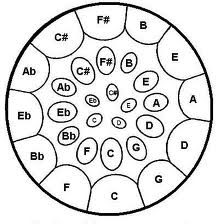
Steelbands can be made up of only a couple of people or up to 150. Steelbands are ensembles of steelpans that feature different sizes and timbres, creating an orchestral sound with many different voicings. Each member of a steelband typically plays two drums, one higher and one lower. These bands participate in Panorama competitions during Carnival, which can be very intense at times.
Here is a performance from the Metronomes Steel Orchestra at the 2014 Panorama Steelband Competition. This is a relatively large ensemble, most likely closer to the 150 cap. As mentioned before, most of the participants are playing two pans at once and there are many different sized pans across the ensemble. I love how energetic everyone in the band is! They are dancing and having such a good time and it makes me wish I was there playing with them.
Calypso Rose:
Born Rose McCartha Linda Sandy Lewis in Bethel, Tobago in 1940, Calypso Rose grew up to become the first woman to ever win the Calypso King competition and the Road March competition. After winning both of these, the Calypso King competition was renamed the Calypso Monarch Competition in her honor. She was also named the Ambassador of Calypso, Trinidad and Tobago's Most Outstanding Woman, and won the International Award for Caribbean Music.
I really wanted to feature Calypso Rose's song "Glass Thief" which is about a man who steals glasses from a woman. It's a really good example of Rose's civil rights activism with sex discrimination and it shows how much of an amazing influence she is on women around the world. Here is another song by Calypso Rose called "Leave Me Alone".
This song has a lot of typical calypso elements such as the African rhythms and upbeat style. The song features a lot of mentions of dancing and jumping, encouraging lots of energetic movement. I highly suggest looking up the music video as well, because it features a lot of costumes and dances from what is most likely Carnival. I love the message and title of this song and I definitely resonate with it in many different ways. Calypso Rose is a truly amazing woman and inspiration.
The calypso traditions of Trinidad and Tobago are very festive and fun, but also very important to their culture. I find is fascinating how calypso is used as a form of communication and political expression, and that it came from slave rebellion and black empowerment. I also love steelpans and their unique sound, don't you?
Bibliography:
“Calypso Music.” Calypso Music - New World Encyclopedia. Accessed February 4, 2021. https://www.newworldencyclopedia.org/entry/calypso_music.
Fairley, Jan. “Calypso.” Oxford Music Online. Oxford University Press, January 20, 2001. Last modified January 20, 2001. Accessed February 4, 2021. https://www.oxfordmusiconline.com/view/10.1093/gmo/9781561592630.001.0001/omo-9781561592630-.
MasterClass. “Soca Music Guide: 9 Types of Soca Music - 2021.” MasterClass. MasterClass, November 9, 2020. Last modified November 9, 2020. Accessed February 4, 2021. https://www.masterclass.com/articles/soca-music-guide#what-are-the-origins-of-soca.
Properleigh. “What Is a Steelpan?” Preservation. Last modified October 7, 2015. Accessed February 4, 2021. https://barrelstobeethoven.com/2015/10/07/what-is-a-steelpan/.
Ramm, Benjamin. “The Subversive Power of Calypso Music.” BBC Culture. BBC, October 11, 2017. Last modified October 11, 2017. Accessed February 4, 2021. https://www.bbc.com/culture/article/20171010-the-surprising-politics-of-calypso.
“Trinidad & Tobago: Trinidad - Music from the North Indian Tradition.” Smithsonian Folkways Recordings. Smithsonian Institution, n.d. https://folkways.si.edu/trinidad-tobago-trinidad-music-from-the-north-indian-tradition/world/music/album/smithsonian.
Trinidad and TOBAGO - music and performing arts. (2007, November 06). Retrieved February 04, 2021, from https://www.smithsonianmag.com/travel/trinidad-and-tobago-music-and-performing-arts-18393257/.


Hey Cassandra! I really enjoyed reading your entry on the steel pan! It's crazy that these instruments were made from scrap and trash but then was used as a percussion instrument! I also really loved the Calypso Rose music, just one more person to add to my playlist. Thank you for this Cassandra!
ReplyDeleteHey Cassandra, I really loved your blog! I didn't know anything about calypso and the Soca and rapso music, there are so many different styles! However, I have come across the steelpans but I didn't know that had steelpan bands, so cool! Thank you!
ReplyDeleteHi Cassandra! This blog is great! I honestly had no idea that the original purpose of Calypso was to spread news through music. All the best ways of learning are through music, so why not news? The Calypso festival looks like a lot of fun!!
ReplyDelete